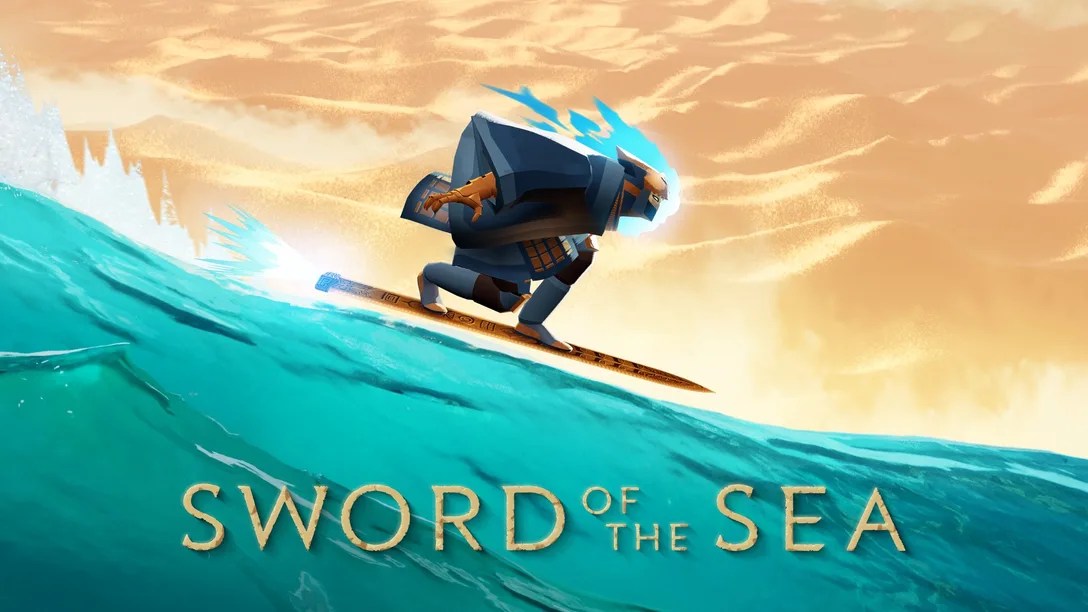
He was a skater boy
Reviewed on: PS5 – Available on: PS5, PC
You know that saying “it’s not the destination, it’s the journey”? That holds water sometimes, you know. Like, I appreciate it’s a larger metaphor for personal growth, practice making perfect, and all that. But, in a very literal sense, going somewhere can be more enjoyable than being somewhere. In 2016, a group of mates and I drove down to Paris to watch some football on a big screen. Most of my best memories from that weekend come from travelling down “le autoroute” (my French isn’t great), rather than standing in the park with a strange, non-alcoholic, lemon-flavoured beer in hand. The journey, sometimes, trumps the journey.
Sword of the Sea is a game about the journey. Giant Squid’s latest places you in the shoes of a wraith; a blue knight-like figure tasked with restoring life to a desolate world. Across a handful of areas, you’ll zoom from corner to corner, locating seeds that convert the desert into an ocean, and reawakening the world around you.
Heaven is a halfpipe
And you do so on your hoverboard (hoversword?). Skating across the desert, and, later, the ocean, is a joy. Rarely is a game as fluid as Sword of the Sea. Darting across these landscapes is a joy in itself. Something as simple as movement shouldn’t feel this satisfying, and yet, half an hour in, I’d made no headway in the actual game, and had, instead, tried my hand at chaining together as many skateboard-like tricks as possible. Having a running “score” on the pause menu is a stroke of genius, by the way. Especially in a game that gives you no real indication as to how your points are racking up. I found myself checking my score every 20 minutes or so, just to see how sick I was being.

As you venture forward, you collect “tetra”; a triangular currency that the world’s travelling vendor will exchange for the ability for you to do more tricks. It’s all largely superficial, granted. The game doesn’t really require you to do much more than some fairly basic platforming. But when movement and trickery is as satisfying as it is here, why wouldn’t you go out of your way to enjoy it?
Sword of the Sea’s momentum is relentless, too. Not a second is wasted. Once you lock into the task of tidying up this land, you get swept up in the journey. Across its 3ish hour story, Sword of the Sea constantly drives you forward, at pace. You’re constantly on the move, and as the game introduces an element of speed around half way through, it becomes a far more kinetic experience than I was really expecting. The use of the haptic rumble on the PS5’s DualSense controller is really nice, too, adding the games fluidity in a way only a few games have achieved on the platform.
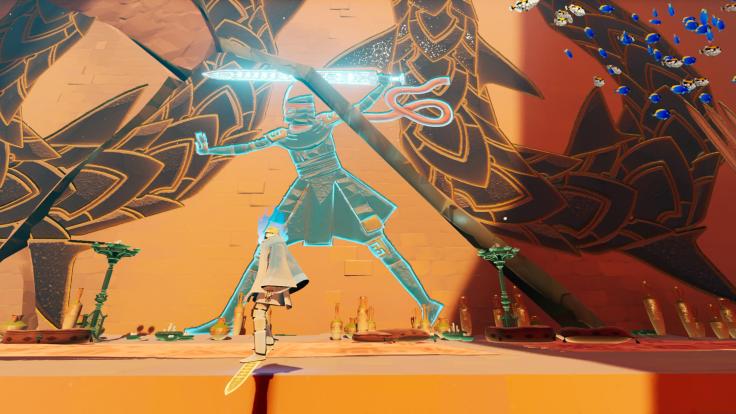
He on X-Games mode
Those who have played a Giant Squid game will be familiar with the look and feel of Sword of the Sea instantly. The world is vibrant, filled with bright block colours that just pop. The particle work is lovely, too. Mix that all in with absolutely solid (minutes a slight dip in the latter blows of the game), and you’ve a very handsome package. Add in a gorgeous, haunting at times, score, and you cannot help but be impressed by how Sword of the Sea is presented.
If I have one criticism, it’s that the game’s story and lore just isn’t overly prominent. The world’s history is tucked away on a handful of stone tablets, and the story is told without voices or words, just actions. What it amounts to is a story that feels half told. Inferences, rather than explicits. It makes for a somewhat muddy narrative that does leave you wanting a little more structure to look back on.
Conclusion
But that’s just it. It’s the journey. As the credits rolled, my first thought wasn’t to unpick the game’s ending, but to think back on how we got there. It flashed up with my total score, and offered me a new game plus. I played Sword of the Sea in one sitting. The next day, I did it again. I might even do it again tomorrow. When the journey is this good, who cares about the destination?

Featured Image Credit: Giant Squid Studios
 Yet Another Gaming Blog
Leave a comment